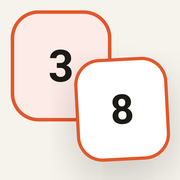
A Puzzle Named After Double-Entry Bookkeeping
If you’ve ever looked at a spreadsheet or a bank statement, you already know the two words at the heart of Paciolino: debit and credit. In accounting, every transaction is recorded twice — once as money out, once as money in — so the books stay balanced. Paciolino turns that idea into a daily logic puzzle.
Each day, you get a new grid of numbers. Your task: mark every number as either a debit or a credit so that every row and every column balances. The site promises exactly one solution, reachable by logic alone — no guessing, no login, no cost.
What Does It Mean to “Balance”?
A row balances when the sum of its debit values equals the sum of its credit values. The same is true for a column. So if a row contains numbers like 2, 3, and 5, you might mark the 2 and 3 as credits and the 5 as a debit — because 2 + 3 = 5.
But Paciolino isn’t just about rows. Each cell sits at the intersection of one row and one column. That means your marking must work for both dimensions at once. The number that helps balance its row is also playing a part in balancing its column.
This is the clever core of the puzzle: a single choice — debit or credit — has consequences in two places. You can’t fix a row in isolation and then move on; every cell is also part of a column waiting to be balanced.
The Daily Grid
Open the site and you’ll find today’s puzzle waiting. It’s a square grid filled with numbers, and each number needs a mark. You’ll probably toggle between two states: debit or credit. Once you’ve labelled every cell, the whole grid should satisfy the balance condition for all rows and all columns.
Because there’s only ever one solution, you can trust the logic. If something seems balanced but only by guessing, you’ve likely missed a constraint. The puzzle is designed so that careful reasoning is enough.
Getting Started in Plain Steps
If you’re brand new, here’s a simple way to approach your first puzzle:
- Open today’s grid at paciolino.com.
- Look at one row and notice the numbers. Your goal is to split them into two groups with equal sums.
- Pick a number and mark it as either debit or credit. At first, these marks are just your best logical guesses.
- Check the column that the cell belongs to. Does your choice help that column balance too?
- Keep going, using the row and column totals to guide your next mark. Once every number is marked and every row and column balances, you’re done.
You’ll likely find that focusing on one row reveals information about several columns at once. That’s where the real puzzle lives.
Tip: Think of each number as a coin being placed on two scales at the same time — one for its row, one for its column. A single move has to tip both in the right direction.
Is There More to the Site?
Yes. Once you finish a puzzle, you can check your stats, browse the archive of previous daily grids, and see how you stack up on the leaderboard. There’s also a dedicated “How to play” page if you ever want a refresher.
But to start, you only need to remember the tagline: every row balances, every day. Mark every number as a debit or credit, satisfy the rows and columns, and you’ve solved Paciolino. No guessing required.
Frequently Asked Questions
Do I need an account to play?
No. Puzzles are free, and you can play without signing in.
What happens if my rows balance but a column doesn’t?
That means at least one of your marks is wrong. Because every cell belongs to both a row and a column, you can’t finish until both dimensions align.
Is there more than one correct solution?
No. The site says every puzzle has exactly one solution, reachable by logic alone.
Where can I play?
At paciolino.com, where a fresh puzzle appears each day.